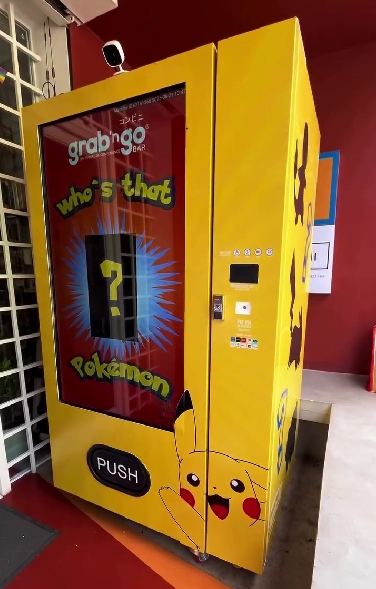
WEIMI Pokemon Vending Machine System
How the WEIMI Pokemon Vending Machine System Helps Operators Earn More
A Pokemon vending machine system is the combined touchscreen commerce, payment, inventory, cloud-control, dispensing and service layer behind the cabinet. WEIMI uses that layer to help operators sell more intelligently-through richer product presentation, bundles, multi-buy offers and online pickup-while one dashboard simplifies stock, sales and machine supervision across multiple locations.
The strongest vending business is not the machine with the most dramatic screen. It is the operation that keeps desirable products available, presents them clearly, protects them during delivery and gives the operator enough data to make the next decision without driving to every site. This guide explains how WEIMI connects those jobs into one commercial system.
What Is a Pokemon Vending Machine System?
Definition: A Pokemon vending machine system is a purpose-configured retail platform that combines a customer interface, product and price database, payment devices, delivery hardware, connectivity and a remote operator backend for selling trading-card products without a staffed checkout.
The word system matters. A cabinet can hold merchandise, but it cannot decide how a new booster set should be presented, alert an operator that the last profitable box sold, show whether an order completed, or coordinate prices across a route. Those jobs sit in the software and the operating process around the machine.
WEIMI connects Android-based touchscreens with cloud management and configurable delivery hardware. On the WM22-TCG, the verified configuration includes a 21.5-inch touchscreen, Android 11, six shelves with nine lanes, Wi-Fi/4G/5G SIM/LAN connectivity, MDB payment integration, an elevator, a delivery camera and anti-drop spiral retaining tabs. The wider WM600 Pokemon vending machine is documented with a 21.5-inch screen and a customizable six-by-twelve layout.
The operator still controls the commercial fundamentals: authentic sourcing, purchase cost, selling price, venue agreement, tax, payment fees, replenishment and service. Software makes those decisions faster and more repeatable; it does not make poor merchandise economics disappear.
Buy a Pokemon vending machine as an operating system with hardware attached-not as a decorated cabinet that happens to take payments.
Profit Comes From the Control Loop, Not One Feature
Revenue and profit are different. A discount can lift unit volume while reducing gross profit. A large capacity can reduce restock frequency while tying up cash in slow inventory. A screen can attract attention while showing the wrong product. The operator needs a loop: observe demand, adjust the offer, confirm execution and repeat the winning decision across suitable locations.
The manufacturer's position
WEIMI's position is direct: remote control is valuable only when it changes an operating decision. Live inventory should decide the next restock. Sales by SKU and hour should shape the planogram. A delivery video should settle a genuine vend dispute. A multi-buy rule should serve a defined margin and turnover goal. Fleet software should reduce unnecessary site visits, not add another dashboard nobody uses.
Consider a six-machine route. If the operator visits every location on the same schedule, the van may carry the wrong sets and arrive at machines that do not need service. If the dashboard identifies two low-stock locations, the route can be built around actual need. The business benefit comes from a better decision: fewer speculative visits, fewer sold-out best sellers and more accurate replenishment.
Every software module should improve one term in that equation. Product pages and promotions address conversion and basket size. Inventory alerts address availability and route cost. Remote motor control addresses downtime and service travel. Order records address refunds and dispute handling.
The economic value of smart vending is not 'automation' in the abstract. It is the accumulation of better pricing, availability, merchandising and service decisions.
Six Revenue Levers Built Into the WEIMI System
A Pokemon vending machine has only a few seconds to turn curiosity into a transaction. WEIMI gives operators several ways to improve that moment without placing a salesperson beside the machine.
Explain the product before checkout
Upload images, set information, selling points and pricing so buyers can compare products on screen instead of guessing from a small pack behind glass.
Use operator-defined multi-buy pricing
Configure quantity discounts for selected SKUs. The operator chooses the threshold and discount, so the promotion can be checked against cost and target margin first.
Bundle fast and slow inventory
Pair a popular pack with a slower set or an accessory. Mix-and-match rules create a reason to add a second item while helping rebalance stock.
Offer relevant add-ons
Present sleeves, deck boxes or related products during the purchase path. A useful cross-sell can increase basket value without slowing the transaction.
Schedule offers around demand
Time-based pricing and promotional content can be configured for launches, tournaments or venue-specific periods, subject to local pricing rules.
Connect online buying with machine pickup
Optional O2O workflow lets the operator bind an order to a lane and issue a QR or numeric pickup code for later collection at the machine.


A simple basket-size scenario
Suppose a buyer intends to purchase one item at $5. A three-item bundle priced at $13.50 raises that transaction's revenue to $13.50, but it is only a good promotion if merchandise cost, payment fees, venue share and tax still leave an acceptable contribution. The system can present and execute the offer; the operator must approve the math.
Smart promotions should have a job-raise basket value, accelerate a chosen SKU or support a launch. 'Discount everything' is not a strategy.
How One Operator Manages Multiple Pokemon Vending Machines
Fleet-management definition: Multi-machine management is the ability to view and act on sales, inventory, order and machine-status information for several vending units through one connected operating process.
The WEIMI cloud backend supports remote monitoring of sales, stock and machine status. Permission-controlled staff accounts can separate day-to-day replenishment from administrative control. Where the approved configuration supports it, an operator can remotely rotate a motor to address a selected delivery problem. Low-stock, sold-out, power or network notifications help the team respond by priority.


A practical daily control routine
- Check exceptions first. Review offline machines, failed orders, motor errors and urgent alerts before reading sales totals.
- Read stock by location and lane. Identify which high-demand SKUs are approaching the operator's refill threshold.
- Build the route from actual need. Visit machines that need merchandise or physical service; do not drive merely to discover stock.
- Prepare location-specific refill bins. Pack the right sets, boxes and accessories for each machine before the vehicle leaves.
- Review selling patterns. Compare SKUs, times and sites over a meaningful period instead of reacting to one unusual day.
- Update offers deliberately. Change prices, bundles or content where the evidence supports a test, then record what changed.
- Standardize the winner. Replicate a proven planogram or promotion only across locations with similar customer intent.
Reports can support bookkeeping and performance review, but operators should still reconcile the platform with payment-processor settlements, cash collection where used, taxes and their accounting system. A transaction log is an operating record, not a substitute for financial controls.
The fleet dashboard should answer three questions every morning: What needs attention, what needs stock and what should change?
From Vend Event to Better Decision
A connected system creates value when data travels both ways. The machine sends orders, inventory changes and status information to the backend. The operator sends approved products, prices, promotions, media and supported control actions back to the machine.
1. Customer chooses
The touchscreen presents an organized product catalog with images, details, price and available promotions.
2. Payment is authorized
The selected payment hardware processes the transaction under the local provider's rules and settlement terms.
3. The machine delivers
The configured coil, pusher, belt, hanging lane or elevator moves the approved SKU toward collection.
4. The order is recorded
Stock and order status update; camera-equipped configurations can associate delivery footage with an order for operational review.
5. The operator learns
Sales, stock, alerts and reports reveal what sold, where it sold and which exceptions require action.
The delivery camera deserves precise expectations. It supports order review and dispute handling; it does not replace product testing, correct loading or local privacy compliance. Recording, retention and access policies should be configured for the jurisdiction and venue.
A reliable closed loop connects merchandising, payment, delivery evidence and stock data. Breaking any one link weakens the business result.
Professional System Comparison
The competitor benchmark matters because buyers should distinguish a purpose-built operating platform from a machine that is merely online. VMFS publicly documents sales by slot, low-stock notifications, remote pricing, fault alerts and an all-machines fleet view. WEIMI covers those core cloud jobs and additionally documents operator-defined bundles, multi-buy and time-based pricing, product-detail content, supported remote motor control, optional O2O pickup and order-linked delivery video on applicable models.
| Capability | WEIMI Pokemon vending machine system | VMFS TCG system as publicly documented | Basic offline or local-control machine |
|---|---|---|---|
| Product merchandising | Images, detailed product information, video and configurable screen content | Slots configured for product formats; reviewed page emphasizes configuration | Usually labels, keypad numbers or local screen content; verify per machine |
| Promotion tools | Bundles, multi-buy, mix-and-match, cross-sell and documented time-based pricing options | Remote pricing is documented; other promotion types were not stated on the reviewed page | May require on-site price changes or may not support promotion logic |
| Inventory and sales | Real-time stock, live sales, best-seller analysis, alerts and exportable reports | Real-time transaction log, inventory by slot and low-stock notifications | Manual count or local records |
| Multi-machine view | Connected backend for multiple machines with permission-controlled staff access | All machines in one dashboard and one login | Machines checked individually |
| Remote intervention | Supported remote motor rotation plus operating-status monitoring | Fault alerts are documented; remote motor action was not stated on the reviewed page | Usually requires a site visit |
| Order evidence | Built-in delivery camera and order video on applicable configurations | Not stated on the reviewed page | Typically none unless separately added |
| Online-to-offline pickup | Optional order binding with QR or numeric pickup code | Not stated on the reviewed page | Typically unavailable |
| Customization scope | Cabinet, lanes, payments, screen content and selected software functions through OEM/ODM scoping | Size, screen, payment, capacity, finish and slot configuration are documented | Often limited to wrap, payment reader or local settings |
'Not stated' means the capability was not found on the reviewed competitor page; it does not claim that the vendor cannot provide it. Final functionality, licensing, payment availability and integration scope must be confirmed in each supplier's written quotation.
Compare the operator workflow, not feature names. Ask each supplier to demonstrate the same tasks: find a low-stock lane, change a price, investigate a failed vend and control user permissions.
Match the Software to the Right WEIMI Hardware
The cloud layer is shared operational logic, but the machine still has to fit the merchandise and venue. WEIMI's Pokemon vending machine range spans large interactive units, elevator machines, narrower cabinets and wall-mounted formats.

Protected delivery and order review
The WM22 elevator and camera model is the strongest fit where packaging condition, mixed product dimensions and vend evidence matter.

High-visibility digital storefront
The 55-inch full-touch model uses a 55-inch display, Android 11, a six-by-nine layout and Wi-Fi, SIM or LAN for malls and flagship locations.

Higher-capacity mixed retail
A documented six-by-twelve layout and 21.5-inch interface give the WM600 room for packs, boxes and accessories while retaining the same remote merchandising discipline.

Compact and wall-mounted formats
The mini wall-mounted card dispenser and WM10-style narrow units suit sites where the assortment is focused and floor space is limited.
Send real product samples or exact measurements before the lane plan is frozen. Booster packs, sleeved packs, ETBs, rigid slabs and sealed boxes behave differently. Software cannot compensate for a lane that is physically wrong for the SKU.
Standardize the backend where possible, but choose the cabinet and delivery method from the product mix and location-not from a fleet photo.
What Real WEIMI Deployments Teach Operators
Customer deployments are most useful when they reveal operating choices, not when they are presented as guaranteed returns. WEIMI case imagery includes branded card-retail projects for Fanstand, an Australian TCG customer and another trading-card operator. These examples show that the same software idea can sit behind different cabinet sizes, wraps and assortments.


Published WEIMI-related cases also document a U.S. card retailer using elevator-equipped machines for 24/7 card sales. The defensible lesson is not a universal sales percentage. It is that unattended TCG retail can be configured for real venues when the operator aligns protected delivery, payment, remote stock visibility and a workable refill process.
What the images show: The images verify completed customer-style deployments and configurations. They do not by themselves prove revenue, ROI, uptime or payback period, so this guide makes no such claim.
Ask a manufacturer for a configuration demonstration using your products and workflow; a generic success photo cannot validate your economics.
What 'Custom Software' Should Mean in a Purchase Order
WEIMI offers OEM/ODM customization for cabinet artwork, screen content and selected software functions. That flexibility is valuable, but 'custom' should never remain a vague sales phrase. Convert it into a written scope with acceptance criteria.
- Interface: languages, currency, product fields, category structure, media formats and customer journey.
- Promotions: quantity thresholds, bundle rules, scheduling, exclusions, tax behavior and reporting.
- Payments: provider, devices, currencies, settlement owner, refunds, offline behavior and certification responsibilities.
- Fleet roles: administrator, route manager, restocker, support user and the exact actions each role may take.
- Integrations: API or file exchange, order identifiers, inventory source of truth, web-store pickup and failure handling.
- Data: server region, retention, export format, account ownership, privacy responsibilities and access after contract changes.
- Support: remote setup, training, update policy, response channel, spare parts and escalation process.
- Acceptance test: named SKUs, payments, promotions, alerts, reports, remote actions and recovery from interrupted connectivity.
Customization can also create complexity. A unique checkout flow requires testing after updates. A regional payment device may change certification, lead time and support ownership. An e-commerce pickup integration needs a clear source of truth so one item cannot be promised online and sold from the lane at the same time.
The best custom software is not the longest feature list. It is the smallest verified scope that creates a measurable operating advantage.
Build a Profit Dashboard Before You Scale
A sales dashboard answers what customers bought. A profit dashboard explains whether the route is worth expanding. Track metrics at machine and SKU level, and separate verified transaction data from assumptions.
- Gross sales: total completed transaction value by machine and period.
- Gross profit: sales minus merchandise cost before route and overhead expenses.
- Average order value: completed sales value divided by completed orders.
- Sell-through: units sold relative to units loaded for the chosen period.
- Stockout time: how long an important lane remains unavailable.
- Service burden: site visits, remote interventions, refunds and unresolved exceptions.
- Route cost: labor, travel, parking and handling associated with replenishment.
- Contribution by site: gross profit minus payment, venue, replenishment and direct service costs.
Run promotion tests with a baseline. Compare a similar period, record the exact rule and monitor both average order value and gross profit. If a bundle increases revenue but consumes margin or empties a high-demand SKU too early, revise it. If a slow accessory moves without harming the core item, the offer may deserve replication.
Scale the repeatable contribution, not the most impressive gross-sales screenshot.
How to Launch and Scale the System in 10 Steps
Define the merchandise
List every pack, box, slab and accessory with dimensions, weight, cost, target price and packaging sensitivity.
Model the site economics
Estimate venue cost, payment fees, tax, refill travel and conservative sales scenarios before selecting a cabinet.
Choose delivery architecture
Match coils, pushers, belts, hanging lanes or an elevator to real samples and the acceptable delivery impact.
Confirm regional payments
Document provider, devices, settlement account, currencies, refund flow, connectivity and local compliance.
Scope the software
Approve user roles, product content, promotions, alerts, reports, O2O pickup and any integration requirements.
Build the content library
Prepare authorized images, descriptions, prices, screen media and translations without using unlicensed character art.
Run factory acceptance tests
Repeat vends with actual products, test every payment path and confirm alerts, remote actions and reporting.
Pilot one operating pattern
Use a defined planogram and restock threshold long enough to distinguish a real pattern from launch-week noise.
Review contribution
Reconcile sales, cost of goods, payment, venue, route and service costs before deciding the pilot succeeded.
Replicate with controls
Copy the proven assortment and workflow to comparable sites, while retaining location-specific pricing and stock rules.
For a configuration proposal, send WEIMI the operating country, venue type, planned quantity, product samples or measurements, preferred payments, connectivity, branding scope and destination postcode. That input is more useful than asking for the 'best Pokemon vending machine' without context.
A scalable fleet begins with a measurable pilot, a documented operating routine and a configuration that can be reproduced.
Questions to Ask Before Signing
Request a live or recorded demonstration of the exact workflow you expect to use. The supplier should be able to show how a product is created, how a promotion is constrained, how stock changes after a vend, how an alert appears, how a user role is limited and how data is exported.
Then inspect the boundaries. Which features are standard, optional or custom? What happens if the network drops during payment? Who owns the cloud account? Can data be exported? Which remote actions are logged? What privacy settings apply to delivery video? Which payment provider supports the destination country? What parts and support channels are included in the written warranty?
The correct answer may differ between a single machine inside a staffed game store and ten units across malls. The point is not to purchase every possible module. It is to make sure the chosen system removes the bottlenecks that would otherwise cap the operation.
Ask for demonstrated workflows, written scope and acceptance tests-not adjectives such as 'smart,' 'cloud' or 'AI.'
Frequently Asked Questions
1. What is a Pokemon vending machine system?
It is the combined customer interface, product database, payment hardware, delivery mechanism, connectivity and remote-management backend used to sell trading-card products without a staffed checkout. A complete system covers both the purchase experience and the operator's daily control work.
2. How can the WEIMI system help an operator earn more?
It can support clearer product presentation, multi-buy offers, bundles, cross-sells, time-based promotions, online-order pickup and 24/7 unattended selling where the venue permits. These tools can improve conversion, basket value or availability, but actual profit still depends on product cost, pricing, fees, location and execution.
3. Can one person manage multiple Pokemon vending machines?
Yes. The cloud backend supports multi-machine monitoring of sales, inventory and machine status, with staff permissions for operational roles. A practical fleet process uses alerts and stock data to prioritize restocking and service instead of visiting every machine only to inspect it.
4. Can prices and promotions be changed remotely?
Supported WEIMI configurations allow remote product and pricing management, plus operator-defined multi-buy, bundle, mix-and-match and time-based promotion rules. The exact module, permissions and regional tax or pricing requirements should be confirmed in the final software scope.
5. What happens if a card pack does not dispense?
On supported configurations, an authorized operator can review order status and use remote motor control for selected delivery issues. Camera-equipped models can record the delivery process for operational review. Physical service may still be required if the cause cannot be resolved safely from the backend.
6. Does WEIMI support real-time inventory?
Yes. The documented cloud tools include real-time stock visibility, sales tracking, best-seller analysis and low-stock alerts. Inventory accuracy still depends on correct loading, product-to-lane mapping and proper handling of refunds, test vends and manual stock changes.
7. Can customers buy online and collect from the machine?
An optional O2O workflow can connect an online order to machine pickup. The operator binds inventory to a lane and generates a QR or numeric code for collection. Integration responsibilities, order synchronization and failure handling should be defined before launch.
8. Can the software and interface be customized?
WEIMI offers OEM/ODM customization for cabinet graphics, touchscreen content and selected software functions. Buyers should specify languages, product fields, promotions, payment methods, user roles, reports, integrations and acceptance tests in writing.
9. Which WEIMI model is best for a Pokemon vending machine fleet?
There is no universal best model. WM22 emphasizes protected elevator delivery and order video; WM55 emphasizes a large interactive storefront; WM600 supports a wider mixed assortment; WM10 and wall-mounted formats suit narrower or space-limited deployments. Select by SKU matrix and venue.
10. Does a smart system guarantee Pokemon vending machine profit?
No. It provides tools to improve merchandising, stock availability, route planning and service response. Profit depends on authentic sourcing, demand, gross margin, payment and venue costs, taxes, replenishment, uptime and management discipline. Buyers should model contribution by site before scaling.
References
- WEIMI - Commercial Pokemon Vending Machines category
- WEIMI - Pokemon Card Vending Machine with Elevator & Delivery Camera
- WEIMI - Full-Touch Pokemon Card Dispenser
- WEIMI - 24/7 Mobile TCG Vending Machine for Traveling Vendors
- WEIMI - Pokemon Center Vending Machine for 24/7 Side Hustle
- WEIMI - Trading Card Vending Machine That Boosts Sales 24/7
- WEIMI - WM600 Advanced Software Ecosystem and Operator OS
- WEIMI - Best Way to Sell Pokemon Cards
- WEIMI case study - U.S. retailer launches 24/7 Pokemon card sales
- VMFS USA - Pokemon & Trading Card Vending Machine System
Vending Machine Price Guide: What Changes the Final Quote?
Pokemon Vending Machine Manufacturer Guide for 2026
Related Article