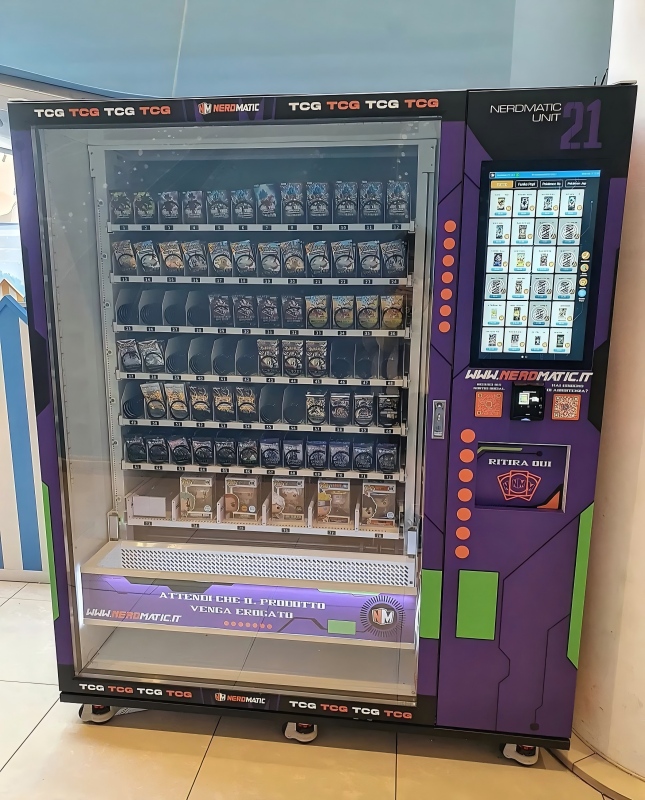
Pokemon Vending Machine Manufacturer Guide for 2026
Pokemon Vending Machine Manufacturer Guide for 2026
Executive answer: A commercial Pokemon vending machine is an unattended retail system configured to sell sealed trading-card products, accessories, boxed collectibles, and—in the right delivery system—graded cards without relying on store hours or counter staff. For a serious operator, the buying decision is not “Which cabinet looks most like Pokémon?” It is “Which dispensing architecture protects my exact product mix, connects to the payments used in my market, and gives me enough remote control to operate the location profitably?”
This 2026 guide takes a manufacturer’s view. It explains what should be engineered before a purchase order is signed, where the WEIMI range differs from compact spiral machines, and how to build an operating plan that survives beyond the opening-week rush.
What Is a Pokemon Vending Machine?
Definition: A Pokemon vending machine is a self-service retail cabinet whose payment, product-selection, dispensing, connectivity, and management systems are configured for Pokémon TCG inventory or related collectibles. The machine may use coils, belts, lockers, or an elevator delivery mechanism; the correct method depends on the dimensions, weight, packaging strength, and value of every SKU.
The term describes a retail use case, not a license. An independent machine that sells lawfully sourced products should not be represented as an official “Pokémon Center” machine unless the operator has written authorization to do so. Exterior graphics, videos, character art, music, and logos require their own review. A responsible manufacturer supplies the equipment and integration; the operator controls merchandise sourcing, local compliance, and brand permissions.
Why trading cards need purpose-configured hardware
A snack coil can move a packet, but that does not make it the right mechanism for a collectible. Booster packs can catch between spirals. Elite Trainer Boxes and premium boxes vary widely in depth and mass. PSA-style slabs are rigid but vulnerable to impact and cosmetic damage. Mystery boxes can be heavier than their footprint suggests. A single cabinet may therefore need several lane widths or more than one delivery method.
Product protection is commercial protection. A bent pack, crushed corner, or hard-dropped slab creates a refund problem and damages trust at the exact moment an unattended store needs to prove it is reliable.
Key takeaway: Choose the delivery architecture from a measured SKU list; do not force valuable inventory into a mechanism chosen for a lower machine price.
Why Operators Are Building Automated TCG Retail in 2026
Trading-card demand has a useful retail pattern: releases create sharp attention peaks, collectors understand the product before they arrive, and many purchases are time-sensitive. A machine can extend a game store after closing, give a mall operator a compact new category, or let a route owner test demand without staffing a complete shop.
The strongest sites combine traffic with intent. A busy corridor is helpful; a corridor used by families, collectors, players, or entertainment visitors is better. Arcades, cinemas, hobby stores, tournament centers, university common areas, family entertainment venues, and selected mall zones can all work. The machine still needs permission, safe access, network coverage, suitable power, and a restocking route.
Automation does not turn weak unit economics into good unit economics. It removes a set of operating constraints: opening hours, a permanently staffed counter, manual price labels, and the need to visit every machine merely to learn what sold. Profit still depends on authentic inventory, purchase cost, sell-through, card fees, venue terms, shrink, tax, freight, service, and replenishment labor.
A manufacturer’s position: operational control beats novelty
The spectacle of a collectible vending machine wins the first glance. Reliable delivery and disciplined fleet management win the second year. Buyers should prioritize four things in order: product safety, payment compatibility, remote operations, and maintainability. Screen size and exterior graphics matter, but only after the machine can vend every approved SKU repeatedly.
Key takeaway: A Pokemon vending machine is a retail endpoint, not a passive box. Evaluate it as hardware, software, payments, merchandising, and field service working together.
WEIMI Pokemon Vending Machine Range
WEIMI offers several commercial configurations rather than one universal cabinet. The Pokemon vending machine category includes systems for compact packs, mixed-size boxed products, high-value collectibles, mobile TCG retail, and large-format interactive selling. The models below illustrate why buyers should begin with products and locations, not a stock photograph.
WM22: elevator delivery with delivery verification
The WM22 elevator and delivery-camera model is the protective-delivery option for fragile or higher-value items. Instead of allowing merchandise to fall the full cabinet height, an elevator travels to the selected shelf, receives the product, and lowers it toward the collection point. A delivery camera adds evidence and feedback around the vend event.
This architecture is suited to boxed releases, rigid holders, graded cards, larger bundles, and mixed inventory where drop distance is a concern. The camera is not a substitute for correct loading or SKU tests; it is part of a closed-loop delivery design that helps the system determine whether the transaction completed.
55-inch full-touch model: a digital storefront
The 55-inch full-touch card dispenser measures W116 × D83 × H194 cm and is configured with six levels and nine slots. It runs Android 11, connects through Wi-Fi, SIM, or LAN, and can be specified for coin, banknote, card, and e-wallet payments. RS232 and MDB interfaces support integration requirements.
Its large screen changes the merchandising job. Operators can show product details, launch content, pricing, and promotions at full visual scale. That is valuable in a flagship game store or mall where the machine must stop traffic before it can convert traffic. Optional refrigeration exists in the platform, although normal sealed TCG inventory usually needs environmental stability rather than active cooling; the buyer should confirm local humidity and temperature requirements.
WM10 Elite Series: compact screen, protected collectible delivery
The WM10 Elite Series measures W87 × D88 × H198 cm with six levels and nine slots. It combines a 10-inch touchscreen, Android 11, Wi-Fi plus 4G/5G SIM and LAN connectivity, MDB-compatible payments, custom wraps, and an elevator-style delivery concept designed to reduce drop impact.
This model fits operators selling a curated mix of Pokémon packs, sports cards, mystery boxes, and premium collectibles. It uses less frontage than the 55-inch model but retains remote pricing, telemetry, inventory alerts, and sales reporting. For a route that values merchandise protection more than billboard-scale media, that balance can be compelling.
WM600: higher-capacity mixed collectible retail
The WM600 platform is documented at W162 × D95 × H195 cm, with six levels and twelve slots, a 21.5-inch touchscreen, Android 11, Wi-Fi, SIM and LAN connectivity, MDB, and configurable bill, coin, card, e-wallet, IC, or ID-card devices. The wider face supports a broader assortment of boxed products and accessories. It can also run multi-buy discounts, bundles, mix-and-match promotions, and time-based offers.
That combination works for operators who want to sell more than booster packs: deck boxes, sleeves, binders, sealed boxes, sports cards, and other authorized collectibles can share the cabinet after lane dimensions and vend behavior have been tested.
Key takeaway: WEIMI’s practical advantage is configuration breadth: large-format selling, compact protected delivery, and higher-capacity mixed merchandise can be matched to different sites instead of forcing every operator into one cabinet.
Professional Comparison: Which Delivery System Fits the Product?
| Configuration | Best-fit inventory | Delivery and merchandising strength | Trade-off to evaluate | Best-fit venue |
|---|---|---|---|---|
| WEIMI WM22 elevator + camera | Graded cards, sealed boxes, bundles, premium packs | Reduced drop distance plus visual delivery verification | More moving components; confirm service access and spare-parts plan | Card shops, tournament centers, premium unattended retail |
| WEIMI 55-inch full-touch | Booster packs, boxes, accessories, mixed collectibles | Largest media surface; configurable 6 × 9 layout | Requires more visual planning and wider placement clearance | Malls, flagship stores, cinemas, high-traffic entertainment sites |
| WEIMI WM10 Elite Series | Mystery boxes, packs, sports cards, higher-value items | Elevator-style protection in an 87 cm-wide cabinet | Smaller screen and fewer lanes than WM600 | Arcades, hobby stores, curated premium sites |
| WEIMI WM600 | Mixed-size boxes, packs, sleeves, binders, merchandise | 6 × 12 capacity, 21.5-inch screen, promotion engine | 162 cm width demands more floor space and delivery planning | Large game stores, malls, multi-category collectible retail |
| Compact coil-based machine | Uniform protected packs in tested holders | Simple mechanism, small footprint, lower acquisition complexity | Less suitable for fragile, irregular, or heavy merchandise | Low-SKU pilots and space-constrained locations |
The compact coil approach deserves respect where it fits. The competitor guide from VTM describes a 22 mm coil paired with a protective pack case and publishes small wall-mounted configurations. That can be efficient for a narrow assortment of uniform packs. WEIMI’s position is different: once the planned assortment includes premium boxes, graded cards, bundles, variable dimensions, large interactive content, or a multi-category roadmap, a configurable cabinet and elevator delivery become strategically valuable.
Key takeaway: There is no universally superior dispensing system. There is only a system validated—or not validated—for the operator’s real SKU matrix.
Hardware Features That Protect Sales and Inventory
Build a measured SKU matrix
Record width, height, depth, weight, packaging material, selling price, and drop sensitivity for every SKU. Include the protective sleeve or case exactly as it will be loaded.
Match trays and delivery mechanisms
Assign each product to a verified lane, belt, locker, or elevator configuration. Mixed boxes may require adjustable dividers and different motor settings.
Test repeated vends before shipment
One successful sample is not enough. Test multiple units from the real packaging run, including slightly bowed packs and the heaviest acceptable box.
Confirm the customer collection path
Inspect drop height, access-door size, anti-fishing design, and retrieval ergonomics. A delivered item still fails commercially if the buyer cannot remove it cleanly.
Plan security for the inventory value
Use appropriate locks, cabinet anchoring, monitored venue placement, and controlled refill procedures. Do not display high-value single cards without a documented risk plan.
WEIMI’s elevator-equipped models address the moment that conventional vending handles poorly: the transfer from shelf to pickup. The delivery camera adds another operational signal, while illuminated shelving and touch displays improve product identification. Custom lane layouts prevent an operator from wasting valuable space on a one-size-fits-all snack planogram.
Key takeaway: Packaging is part of the machine specification. Send physical samples or exact dimensioned drawings before the tray plan is frozen.
Software: The Difference Between One Machine and a Fleet
A connected vending machine should answer five questions without a site visit: What sold? What remains? What failed? What price is live? What needs attention? WEIMI’s smart vending backend is designed around that operational loop.

Remote inventory and sales visibility
Operators can track sales and stock status across connected machines, identify fast-moving SKUs, and use low-stock alerts to plan replenishment. This is especially useful around new card releases, when yesterday’s average restocking schedule can become obsolete in hours.
Remote price and promotion management
Prices, product information, advertisements, and supported promotions can be changed remotely. The WM600 documentation includes multi-buy discounts, bundle pricing, mix-and-match offers, and time-based campaigns. These tools should be used transparently: show the exact products, final price, quantity, and any limits before payment.
Remote fault response
Selected configurations support order or motor alerts and remote motor rotation. If a vend stalls, an authorized operator can diagnose the event and attempt a controlled release without immediately sending a technician. Delivery verification helps separate a genuine failed vend from a completed order.
Connectivity and operating environment
WEIMI models in this guide use Android 11 and can connect by Wi-Fi, cellular SIM, or LAN. A deployment should define a primary connection, a fallback, signal strength, data ownership, software access, alert recipients, and what the machine does if the network drops mid-transaction.
Key takeaway: Remote management is not simply a dashboard feature. It is the control system for pricing, replenishment, uptime, refunds, and route labor.
Payments, Localization, and Integration
Payment hardware is regional. “Supports cards” is not a complete procurement answer. The buyer must identify the acquirer or payment provider, card networks, contactless wallets, cash requirements, settlement currency, SIM needs, certifications, transaction fees, tax receipt rules, and chargeback workflow in the destination market.
WEIMI platforms can be configured for bill, coin, bank card, e-wallet, IC, and—in relevant applications—ID-card devices. MDB and RS232 options support common integration paths, but the exact peripherals must be approved in the formal configuration. The touch interface, language, currency, tax display, promotional media, and receipt behavior also need localization.
For omnichannel projects, selected WEIMI configurations can support QR-code collection workflows that connect an online order to an unattended pickup point. Treat this as an integration project, not a checkbox: define order reservation, expiry, stock allocation, identity or code validation, refunds, and the response to a compartment or delivery failure.
Key takeaway: Confirm the named payment terminal and provider for the destination country before production; do not approve a quotation that lists only generic payment categories.
What a Professional Manufacturer Should Deliver
A dependable Pokemon vending machine manufacturer should translate a business case into a controlled bill of materials. That includes cabinet dimensions, tray map, delivery mechanism, payment devices, network hardware, screen, operating system, graphics files, voltage and plug, software account, spare parts, packing, shipping terms, installation responsibilities, and acceptance tests.
WEIMI states more than nine years of vending manufacturing experience, installations across 100 countries, and more than 30,000 machines in operation. The company provides an 18-month component warranty and remote technical support; final warranty coverage, parts, and service procedures should still be written into the sales contract for the selected configuration.
The factory acceptance test should verify dispensing channels, the touchscreen, connectivity, selected payment devices, remote management, alerts, and the approved exterior. Buyers can request a configuration test video before shipment. For higher-volume programs, define a golden sample and repeatable acceptance checklist rather than approving each unit informally.
Evidence before scale
WEIMI publishes installation imagery on collectible-machine product pages and maintains a broader customer-case library. Public pages do not consistently identify TCG customer names, exact locations, or audited revenue. Serious buyers should therefore ask for comparable project references, machine configuration, destination market, service history, and—where confidentiality permits—a reference conversation. That is more useful than an anonymous earnings claim.
Key takeaway: A manufacturer earns authority by documenting limits as carefully as capabilities. Request evidence for the configuration you will actually buy.
How to Launch a Pokemon Vending Machine Business
Define the buyer and occasion
Choose a primary mission: after-hours game-store sales, mall impulse purchases, tournament convenience, premium mystery boxes, or omnichannel pickup.
Secure lawful inventory and artwork
Buy genuine products through authorized channels. Obtain written rights for any exterior art, logos, videos, or other protected brand assets.
Build the SKU matrix
Measure every pack, box, slab, and accessory. Flag fragile items, high-value products, and seasonal SKUs before choosing the cabinet.
Survey the location
Document footprint, door and lift access, power, signal strength, operating hours, security, loading access, and the venue agreement.
Choose the delivery architecture
Use compact coils for tested uniform items; choose elevator delivery for premium, fragile, boxed, or mixed-size merchandise.
Lock the payment specification
Name the payment provider, terminal, networks, wallets, cash devices, currency, settlement account, and compliance owner.
Approve the interface and graphics
Use clear product photography, pack language, quantity, price, refund instructions, and operator contact details. Keep unauthorized marks off the machine.
Run factory and site acceptance tests
Test repeated vends for every lane, payment success and reversal, network loss, alerts, remote price changes, and retrieval access.
Start with a measured pilot
Track traffic, conversion, sales by SKU and hour, failed-vend rate, stockouts, gross margin after fees, and refill time.
Scale only from operational evidence
Duplicate the product mix, venue profile, restocking rhythm, and service kit that worked. Do not scale from launch-week revenue alone.
Location Economics and KPIs That Matter
Ignore universal profit promises. A useful model starts with local inputs: units sold per day, average selling price, landed merchandise cost, payment fees, sales tax, venue rent or commission, software and connectivity, electricity, restocking travel, refunds, shrink, and depreciation. Run base, downside, and release-week scenarios.
Track contribution margin per vend rather than revenue alone. A premium box may create more sales value but consume more capital and cabinet space. A low-priced accessory may improve basket size when offered as an add-on. A popular booster can attract buyers yet create stockouts that waste the rest of the site’s traffic.
Core operating metrics
- Vend success rate: successful deliveries divided by paid vend attempts.
- Stockout hours: hours a demanded SKU is unavailable, not merely the number of empty lanes.
- Gross margin after variable fees: sales less product cost, payment cost, and venue share.
- Average basket: revenue per completed transaction, including multi-buy and accessory attachment.
- Service burden: remote interventions, site visits, parts, and labor per machine per month.
- Inventory days: how long cash remains tied up in each product class.
Key takeaway: The best location is the one that produces repeatable contribution margin with acceptable service effort—not simply the largest crowd.
Common Procurement Mistakes
Buying the wrap before validating the vend
An exciting exterior cannot rescue a tray that damages cards. Approve SKU tests and the product map before final artwork.
Assuming every cashless terminal works everywhere
Payment approval, cellular compatibility, certifications, acquiring, and wallet support vary by country. Confirm the complete chain in writing.
Using generic revenue claims
Competitor guides may publish machine prices, sales assumptions, or payback examples. Use them as scenarios, not forecasts. Your venue terms and inventory cost determine your result.
Skipping the refill workflow
Plan who receives inventory, who opens the cabinet, how stock is counted, how discrepancies are recorded, and how high-value items are transported.
Confusing customization with trademark permission
Manufacturing a custom wrap is technically possible; using protected Pokémon graphics is a separate legal question. The buyer must supply approved assets and permissions.
Why WEIMI Is a Practical Manufacturer for TCG Projects
WEIMI’s strongest case is not a single headline feature. It is the ability to configure cabinet scale, delivery protection, screen format, tray layout, connectivity, payments, promotions, graphics, and remote operations around a product plan. The 55-inch machine serves as a digital storefront. The WM10 balances a compact footprint with protected delivery. The WM22 adds elevator handling and delivery-camera feedback. The WM600 provides a wider, higher-capacity platform for mixed collectibles and accessories.
That range supports a disciplined buying process. Send the destination country, postal code, planned quantity, venue type, product dimensions and weights, preferred payment methods, electrical requirements, and approved graphics. WEIMI can then recommend a layout and prepare an itemized machine and freight quotation instead of treating “Pokemon vending machine” as a complete specification.
To move from research to procurement, request a WEIMI configuration review and include the SKU matrix. A good first response should narrow choices, expose technical dependencies, and identify what must be tested.
Frequently Asked Questions
1. Is WEIMI affiliated with The Pokémon Company?
No. WEIMI manufactures vending hardware and smart vending systems and is not presented as affiliated with, sponsored by, or endorsed by The Pokémon Company, Nintendo, Creatures Inc., or GAME FREAK. Operators must source genuine merchandise and authorized artwork independently.
2. Does a WEIMI Pokemon vending machine include cards?
No. Machines and software are supplied; Pokémon cards and related merchandise are not. The buyer is responsible for inventory from authorized suppliers or distributors.
3. Which machine is best for graded cards or premium boxes?
An elevator-equipped configuration such as WM22 or the WM10 Elite Series is the stronger starting point because it reduces the free-fall delivery distance. Final approval requires product dimensions, weight, packaging, and repeated vend tests.
4. Can one machine sell booster packs, boxes, and accessories?
Yes, if the selected cabinet has a tray map and delivery mechanisms validated for each item. The 55-inch model and WM600 are designed for configurable mixed merchandise.
5. Can operators change prices remotely?
Yes. Connected WEIMI configurations support remote price, product, inventory, and promotional management through the vending backend. Exact functions should be confirmed for the purchased software package.
6. What payments can be installed?
Depending on the destination and approved peripherals, options include banknote, coin, card, e-wallet, and IC payments. Confirm the named provider, terminal, certifications, and settlement arrangement before production.
7. What internet connection does the machine need?
Models in this guide support Wi-Fi, cellular SIM, and LAN connectivity. Choose a primary and fallback connection based on a site survey and define offline transaction behavior.
8. Can the machine’s exterior and interface be customized?
Yes. Exterior wraps, colors, interface language, product layout, and screen content can be customized. The buyer must own or obtain permission for all submitted artwork and media.
9. What warranty does WEIMI provide?
WEIMI states an 18-month warranty on components with remote technical support. The final contract should list coverage, exclusions, spare parts, diagnostic steps, and shipping responsibilities.
10. What information is needed for an accurate quotation?
Provide country and postal code, quantity, venue, product dimensions and weights, payment methods, connectivity, electrical standard, preferred screen and cabinet size, approved graphics, and the desired delivery mechanism.
References
- VTM Vending: The Ultimate VTM Pokemon Vending Machine Guide.
- WEIMI: Commercial Pokémon Vending Machines for Sale.
- WEIMI: Pokémon Card Vending Machine with Elevator & Delivery Camera.
- WEIMI: Full-Touch Pokémon Card Dispenser.
- WEIMI: Pokémon Card Packs Mystery Box Vending Machine.
- WEIMI: Elite Series Mystery Box Vending Machine.
- WEIMI: Signed Athletic Jerseys Lucky Box Vending Machine.
- WEIMI: Customer Case Library.
- WEIMI: About Us.
- WEIMI: Contact and Project Information.
Trademark notice: Pokémon and related names, characters, logos, and trademarks are owned by their respective rights holders. WEIMI supplies vending machines and smart vending systems and does not supply Pokémon merchandise or claim official affiliation.
WEIMI Pokemon Vending Machine System
Are Trading Card Vending Machines Profitable? Costs, Locations, Product Mix & ROI
Related Article