Self-Service Dog Wash Station: Equipment & Site Guide | WEIMI
Self-Service Dog Wash Station: Equipment & Site Guide
Executive answer: A self-service dog wash station combines warm water, controlled liquid dosing, drying, payments and remote management. Select the equipment from the wash-bay footprint, utilities, animal-handling needs and local payment methods.
Operators and buyers can use this guide to define a compact pet wash footprint, confirm water and drainage needs, compare wash functions, specify payments and software, and prepare a complete manufacturer inquiry.
What Is a Self-Service Dog Wash Station?
Definition: A self-service dog wash station is a commercial pet-washing system that lets a customer select and pay for a controlled wash cycle while the operator manages liquids, temperature, equipment status and service tasks. A complete installation normally includes the machine, a suitable pet-wash bay or tub, water supply, drainage, ventilation, safe flooring and a documented cleaning routine.
The terms dog wash machine, pet washing station and self-service pet wash are often used interchangeably. The equipment cabinet controls the service; it is not a substitute for the physical wash area, plumbing design, site supervision or local compliance.
Where the concept fits
An urban pet washing station can serve pet stores, residential communities, service stations, shopping facilities and dedicated pet-care sites where the operator can provide safe access and maintain the wash area. A compact cabinet footprint helps, but the complete site must also allow an animal and handler to move comfortably.
Key takeaway: Treat the project as a small pet-care facility with vending-style payment and remote control, not simply as a cabinet placed beside a drain.
Verified WEIMI Dog Wash Equipment Configuration
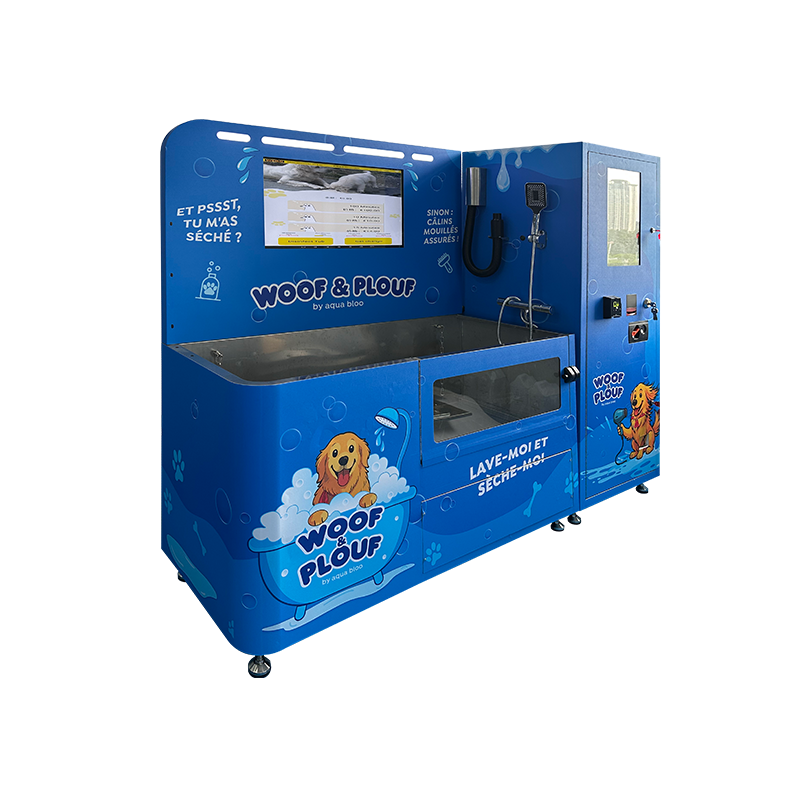
The current WEIMI self-service dog washing station has a narrow W200 x D63 x H180 cm cabinet and a 21.5-inch touchscreen. Its Android 11 controller is specified with 16 GB ROM and 2 GB RAM. Network options include Wi-Fi, 3G/4G SIM and LAN, while MDB and RS232 interfaces support approved payment and peripheral configurations.
Warm-water control
A 30 L hot-water heater and adjustable water-temperature control support a managed wash process. The final installation still requires compatible inlet water, pressure, electrical capacity and drainage.
Four independent liquid circuits
Four pumps draw from four 5 L canisters for shampoo, conditioner, anti-flea/tick solution and disinfectant. Liquid-level sensors help operators identify refill needs.
Two-speed dryer
The integrated dryer provides two selectable speeds. Airflow, noise, hose handling and safe use instructions should be checked in the site acceptance test.
Customer and advertising screens
The 21.5-inch touchscreen presents service controls, while a 32-inch advertising screen can display operating guidance, offers and approved media.
Configuration summary
| System area | Verified configuration | Buyer decision |
|---|---|---|
| Cabinet | W200 x D63 x H180 cm | Confirm delivery route, service clearance and final wash-bay dimensions. |
| Interface | 21.5-inch touchscreen; Android 11; 16 GB ROM / 2 GB RAM | Confirm language, service labels, pricing display and operating instructions. |
| Connectivity | Wi-Fi, 3G/4G SIM and LAN | Survey signal and define primary and backup connection methods. |
| Interfaces | MDB and RS232 | Approve each payment or peripheral model for the destination market. |
| Liquids | Four pumps, four 5 L canisters and liquid-level sensors | Approve products, dilution ratios, labels, refill procedure and storage. |
| Water and drying | 30 L heater, adjustable temperature, showerhead and two-speed dryer | Confirm water, drainage, power, temperature limits and customer guidance. |
Key takeaway: Use the verified configuration as the starting point, then document destination-specific payments, electrical standard, graphics and wash-bay requirements in the quotation.
Compact Pet Wash Footprint and Site Planning
The machine cabinet is 63 cm deep, but a practical pet wash space must be larger than the equipment footprint. Allow for the tub or wash platform, handler position, animal entry and exit, dryer hose movement, cleaning access, splash control and an unobstructed route to the service panels. Buyers searching for a compact pet wash footprint should compare the complete operating envelope, not cabinet width alone.
Map the operating zone
Mark the machine, wash bay, handler standing area, entry gate, collection hooks and safe exit path. Avoid forcing customers to cross a wet service area.
Confirm water and drainage
Specify inlet connection, pressure, water quality, isolation valve, drain capacity, hair interception and access for routine cleaning.
Verify electrical capacity
Confirm voltage, plug, circuit protection, earthing and the load of the heater, dryer, screens and any site lighting with a qualified local installer.
Plan ventilation and moisture control
Remove humidity, manage condensation and protect surrounding surfaces. Enclosed urban locations may require more ventilation than an open service bay.
Survey connectivity
Test Wi-Fi, SIM and LAN availability where the cabinet will stand. Define how payments and alerts behave during a network interruption.
Provide service clearance
Leave enough room to refill liquids, inspect pumps, clean filters, reach plumbing and service electronics without dismantling the wash area.
Flooring and customer movement
Use a textured anti-skid surface suitable for wet pet-care environments, with drainage that does not create standing water. The finish must be compatible with the cleaning products used on site. A "textured anti-skid vending pet wash station" is not one component; slip control depends on the floor, slope, drainage, maintenance and customer instructions working together.
Key takeaway: The best compact design minimizes wasted space while preserving safe animal handling, dry customer circulation and full maintenance access.
Dog Wash Functions, Liquid Control and Hygiene
The WEIMI configuration separates shampoo, conditioner, anti-flea/tick solution and disinfectant through four pumps and four canisters. Independent circuits let an operator define the sequence and liquid ratio instead of relying on customers to measure products manually. Final products and ratios must be approved for the destination market and the intended animal use.
Prepare and rinse
Display clear restraint, temperature and showerhead instructions. The operator should set safe limits and make an emergency stop or contact path easy to find.
Apply selected wash products
Label every function accurately. Keep shampoo, conditioner and any treatment product in the correct canister and document refill checks.
Rinse completely
Instructions should explain how to remove residue from coat and skin while keeping water away from eyes and ears.
Dry at a suitable setting
Use the two-speed dryer according to animal size, coat and tolerance. The customer must be able to reduce or stop airflow quickly.
Cleaning between users
A self-service format still needs active hygiene management. Define who removes hair, cleans the tub and showerhead, checks the hair filter, inspects hoses, refills canisters and records incidents. Disinfectant availability does not prove that a surface is clean or that the selected chemical is appropriate for every material.
- Liquid status: check sensor alerts and confirm the physical canister level.
- Hair control: empty and clean the filter before flow becomes restricted.
- Temperature: verify the displayed setting and actual outlet condition.
- Customer guidance: keep wash instructions visible, legible and current.
Key takeaway: A reliable pet wash is created by controlled dosing plus a documented human cleaning routine.
Payments, Connectivity and Remote Management
WEIMI can configure coin, cash, card and e-wallet payment methods. Availability varies by country, acquirer, terminal certification and network. A serious specification should name the payment provider, accepted methods, currency, settlement account, connectivity and behavior when a transaction or wash cycle is interrupted.
The cloud-based management platform is intended to support connected operation. It can help an operator review sales, equipment status and service needs without visiting the site merely to inspect the cabinet. Exact functions, account access and data fields should be confirmed for the purchased software package.
Local payment configuration
Choose the required coin, note, bank-card and e-wallet devices for the destination. Confirm MDB or RS232 integration and complete transaction testing before shipment.
Three connection paths
Wi-Fi, 3G/4G SIM and LAN options support different sites. The buyer should provide SIM requirements and test the final installation location.
Cloud-based oversight
Define who receives low-liquid, fault or service notifications and who can change prices or operating settings.
Custom graphics and instructions
Custom sticker graphics can carry the venue brand, wash steps, safety notices and contact details. Use approved artwork and durable materials suitable for a wet environment.
Key takeaway: "Cashless" is not a complete requirement. Approve the exact terminal, acquiring arrangement, networks and offline behavior for the country of installation.
How to Evaluate a Dog Wash Station Manufacturer
A self-service dog wash station manufacturer should turn a location plan into a controlled equipment specification. Ask for a dimensioned drawing, fluid diagram, electrical requirements, payment-device list, network plan, screen content requirements, replacement-parts list and factory acceptance procedure.
Verify product facts
Match the quotation to the 21.5-inch screen, 30 L heater, four pumps, four 5 L canisters, temperature control, dryer and selected communication interfaces.
Test every function
Run water, each liquid circuit, level sensing, temperature adjustment, both dryer speeds, screen controls, network paths and all payment devices.
Review service access
Confirm how technicians reach pumps, canisters, heater, filter, controls and payment hardware after the machine is installed.
Approve instructions and graphics
Check wash steps, liquid names, safety language, emergency contact and custom sticker artwork before production.
Factory and site acceptance
The factory test confirms the configured hardware and software. The site test confirms local plumbing, drainage, electrical supply, connectivity, payment settlement, safe flooring and customer movement. Both are necessary because a machine can pass at the factory and still fail in an unsuitable installation.
Key takeaway: Evaluate a manufacturer by the completeness of the specification and test evidence, not by an unsupported payback claim.
Can the Station Be Used as a Self-Service Cat Wash?
Search demand includes phrases such as self-service cat washing station manufacturer and self-service cat bathing machine supplier, but a dog-wash configuration should not automatically be marketed as suitable for cats. Cats can respond differently to restraint, water, noise and forced-air drying. Suitability requires an animal-welfare review, appropriate enclosure and handling design, safe product selection, noise assessment, supervision policy and compliance with local rules.
Buyers planning a multi-species pet washing station should tell the manufacturer before production and consult qualified local animal-care professionals. The standard dog wash equipment facts in this guide do not establish cat suitability.
Key takeaway: Do not relabel a dog wash station as a cat wash machine without a separate welfare, configuration and operating review.
Self-Service Pet Wash Procurement Checklist
- Define the venue: country, site type, indoor or sheltered placement, operating hours and expected supervision.
- Draw the complete footprint: cabinet, wash bay, animal route, handler area, service clearance and drainage.
- Confirm utilities: water pressure, inlet, drain, hair filter, voltage, circuit protection and ventilation.
- Choose functions: approved liquids, ratios, temperature limits, dryer settings and wash instructions.
- Specify payments: exact provider, terminal, cash devices, card networks, wallets, currency and settlement.
- Approve connectivity: Wi-Fi, SIM or LAN, software account, alert recipients and network-loss behavior.
- Prepare graphics: brand artwork, custom stickers, screen language, prices, safety notices and support contact.
- Run acceptance tests: test each liquid line, sensor, payment type, network path, screen, heater and dryer.
- Create the cleaning plan: assign inspection, hair removal, filter cleaning, liquid refill and incident records.
- Model economics locally: use the actual machine and freight quotation, build-out, utilities, payment fees, supplies, cleaning labor, rent and expected local demand.
There is no responsible universal ROI forecast for a self-service dog wash business. Calculate a base, downside and high-utilization scenario with local prices and costs. Keep revenue assumptions separate from manufacturer-verified equipment capabilities.
For an itemized configuration review, send the checklist to WEIMI together with the site drawing and destination postal code.
Frequently Asked Questions
What is the footprint of the WEIMI self-service dog wash station?
The equipment cabinet measures W200 x D63 x H180 cm. The complete installation needs additional space for the wash bay, handler, animal movement, splash control and maintenance access.
Which wash functions are included?
The verified configuration includes shampoo, conditioner, anti-flea/tick solution and disinfectant circuits, adjustable water temperature, a showerhead and a two-speed dryer. Final liquids and settings must be approved for the local market and intended use.
How are the pet-care liquids managed?
The machine uses four independent pumps connected to four 5 L canisters. Liquid-level sensors support refill monitoring, while the operator remains responsible for correct products, ratios, labeling and maintenance.
Does the machine include a hot-water system?
Yes. The current configuration lists a 30 L hot-water heater and adjustable water-temperature control. Local water, power and installation requirements must be confirmed before ordering.
What payment methods can be configured?
Options can include coin, cash, card and e-wallet payments. Exact devices, providers, certifications and settlement arrangements depend on the destination country and should be named in the quotation.
Can the station be monitored remotely?
The system supports cloud-based management with Wi-Fi, 3G/4G SIM or LAN connectivity. Confirm the exact reports, alerts, access roles and remote functions included in the purchased software package.
Can the exterior and instructions be customized?
Yes. WEIMI lists custom graphics as an available configuration. The buyer should supply approved branding, operating instructions, liquid labels, safety notices and support contact information.
Is this dog wash station automatically suitable for cats?
No. Cat suitability requires a separate animal-welfare, enclosure, noise, drying, product and supervision review. The standard dog-wash specification alone does not establish safe cat use.
How should a buyer compare dog wash manufacturers?
Compare verified dimensions, fluid circuits, temperature and drying controls, payments, connectivity, service access, spare parts and acceptance tests. Do not rely on universal revenue or payback promises.
What information is needed for a quotation?
Provide the country and postal code, quantity, venue type, site drawing, utilities, payment methods, electrical standard, connectivity, language, graphics and required wash functions.
Managing 100 Convenience Stores with Just 5 People?
Market Prospect Analysis of Nail Patch Vending Machines
Related Article